
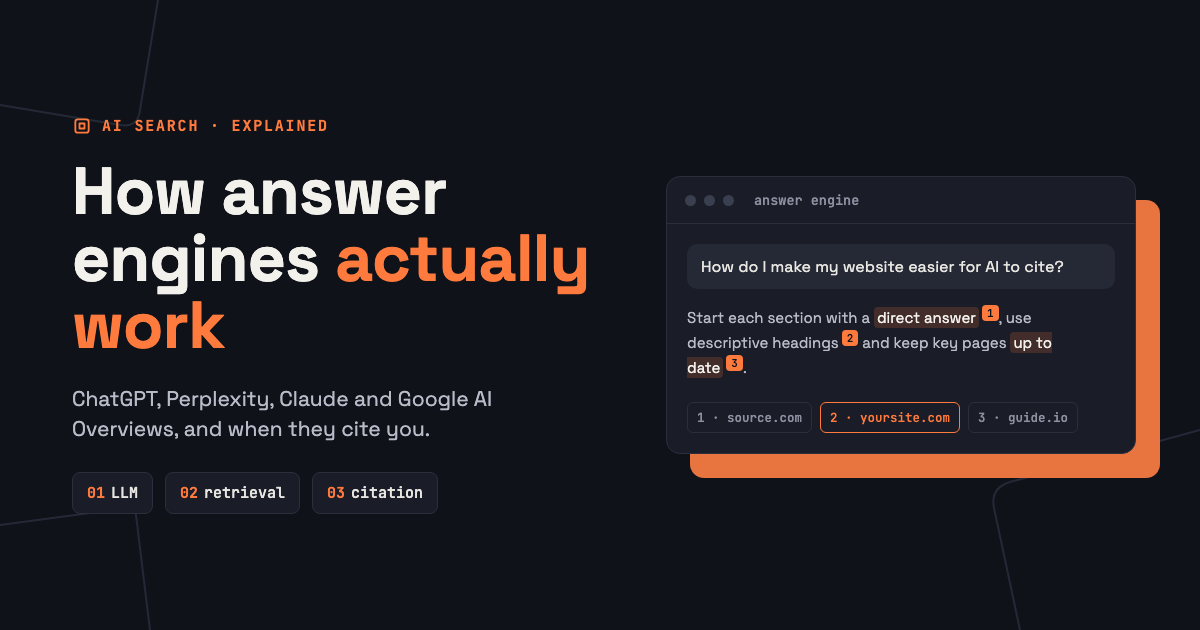
An answer engine is an AI system that answers a question directly instead of returning a list of links. ChatGPT, Perplexity, Claude, Google AI Overviews and voice assistants all work this way. Most are built on a large language model (LLM), and some also search the web in real time, which is when they can cite your website.
Knowing how these systems put an answer together tells you what your content needs in order to be included. Here is a plain-English explanation for marketers and website owners.
Search engine vs answer engine
A traditional search engine gives you a ranked list of pages, and you do the work: open several results, compare them and decide what to trust. An answer engine does that work for you. It gathers information, combines it and gives you one response to read.
For a business, the difference is in what you compete for. In a search engine you compete for a position. In an answer engine you compete to be one of the sources the answer is built from.
What a large language model actually does
An LLM is trained on huge amounts of text, and often code and images too. During training it repeatedly predicts the next word in a passage, checks whether it was right and adjusts billions of internal settings, called parameters. Over time it learns how words, ideas and facts tend to fit together.
A useful comparison is an analyst who has read every report in your industry for years. They can't quote any single report from memory, but they can give you a clear, informed answer by drawing on everything they've absorbed. An LLM answers the same way: it writes something new from patterns, not by copying one source.
Two ways answer engines get information
| Answers from training data | Answers with live web search | |
|---|---|---|
| Where the answer comes from | Patterns learned during training | Pages retrieved for this question, plus the model's knowledge |
| How current it is | Only as recent as the training cut-off | Can include pages published yesterday |
| Citations | Usually none | Often, with links to the pages used |
| Your content gets in by | Being widely published and mentioned before training | Being findable, trustworthy and easy to extract today |
Many tools now do both: they answer from memory for simple questions and search the web when the question needs current or specific information.
The main answer engines
Google AI Overviews
AI-generated summaries at the top of Google's results, powered by Google's Gemini models. They combine several web pages into one answer and link to the sources, but most people get what they need without clicking.
ChatGPT
OpenAI's conversational assistant. It answers from its training data and, when web search is used, adds current information and cites the pages it found.
Perplexity
An AI search tool that searches the web for each question and writes an answer with numbered inline citations. Because it shows its sources so clearly, it's a good place to check which sites get cited for your topics.
Claude
Anthropic's AI assistant. Like ChatGPT, it answers from training data or searches the web when needed, and gives one direct answer instead of a list of links.
Voice assistants
Siri, Alexa and Google Assistant give one spoken answer, usually taken from a featured snippet or an AI summary. There's rarely any visible attribution, but the same content principles apply.
New tools appear constantly. Once you understand these, you can judge any new one by the same questions: does it search the web, and does it cite sources?
What every answer engine has in common
- They want direct answers. The experience is built around one response, so your content needs clear passages that can be lifted out and used.
- They judge trust. They don't take the first result. They check whether a source is credible, whether it agrees with other trusted sources, and whether it's structured clearly. Domain authority, backlinks, author expertise and technical health still matter.
- They don't always link back. A citation may bring a click, or it may only put your brand name in front of the reader. Both build credibility.
So the question for content changes from "How do I get the click?" to "How do I make AI systems see my content as worth citing?"
Ranking vs being cited
A search engine crawls your page, indexes it and ranks it against competitors on hundreds of signals. The output is a position. An answer engine looks for passages relevant to the question, checks whether they're useful, trustworthy and clear enough to extract, and weaves the best ones into its answer. If your page doesn't pass, it may not appear at all, even when it ranks well.
In short: ranking earns you a position on a page; being cited earns you a place in an answer. We explain the practical side of this in What Is Answer Engine Optimization (AEO)?
A word of caution about AI answers
AI answers can be wrong. Models trained on old data can state outdated facts with full confidence, and models that search the web can repeat whatever incomplete or biased content they find. Treat AI answers like any other source: check the important ones. For your own brand, this is another reason to publish accurate, current and consistent information, so the sources AI systems draw from say the right things about you.
Frequently asked questions
Is ChatGPT a search engine?
Not in the traditional sense. It's a conversational AI that can search the web, but its output is a written answer, not a ranked list of pages.
How does Perplexity choose its sources?
It searches the web for each question, picks pages that look relevant and credible, and cites them inline. Clear, well-structured and current pages have the best chance.
Can I see if AI tools cite my website?
Partly. Ask the questions your buyers ask in Perplexity, ChatGPT and Google, and note which sites are cited. Referral traffic from these tools also shows up in your analytics.
Do LLMs learn from my website?
Publicly available pages may be included in training data, and AI tools with web search can read your pages live when answering, unless you block their crawlers.
Need a website that answer engines understand?
We build HubSpot websites with clean structure, fast pages and content your team can keep current. Tell us about your project.